Private Interest in the Public Good: Cholera and the Origins of Sanitary Reform
Gallardo-Albarrán & Kappner: "Private Interest in the Public Good: Cholera and the Origins of Sanitary Reform" CRC Discussion Paper No. 573

European countries paved the way for modern economic growth in the 19th century with large-scale reforms facilitating human capital accumulation. While the literature has analysed the role of elites in broad education investments, less attention has been devoted to the motivations underlying public health reforms, a key requisite of human capital formation. In their recent contribution, Daniel Gallardo-Albarrán (Wageningen University)) and Kalle Kappner (HU-Berlin, Project B08) show how the 1866 cholera epidemic (the deadliest mortality shock in modern German history) incentivized local economic elites to finance clean water supplies, significantly accelerating their adoption where cholera hit hardest. Across Germany’s more than 2,500 cities, this increased the annual opening probability by 0.4 percentage points, or 35% relative to a baseline rate of 1.1% in unaffected cities. To strengthen the causal interpretation of this finding, the authors calibrate an epidemiological model that isolates how troop movements during the 1866 Austro-Prussian war spread the disease, thereby focusing on an exogenous component of the local mortality.
The core of the study’s contribution lies in identifying the economic calculus of local elites, who held decision-making power and bore the costs of public health investments. During cholera epidemics, working-age individuals accounted for roughly two-thirds of the deaths, and skilled workers were not spared. This created a sudden labour scarcity shock, affecting the value of elites’ capital through rising capital-skill complementarity. The authors provide quantitative evidence that commercial and industrial elites, who depended on skilled labour and capital-skill complementarities, stood to lose the most from such shocks and therefore promoted health-enhancing public goods to protect their private interests. In contrast, agricultural elites, whose production processes and capital structures benefited less from preserving skilled labour, were significantly less likely to support these costly reforms, resulting in low waterworks adoption rates even in cities experiencing severe cholera epidemics. These results remain unchanged when controlling for alternative explanations for elites’ willingness to finance water supplies, such as their use as a direct production input in water-intensive industries.
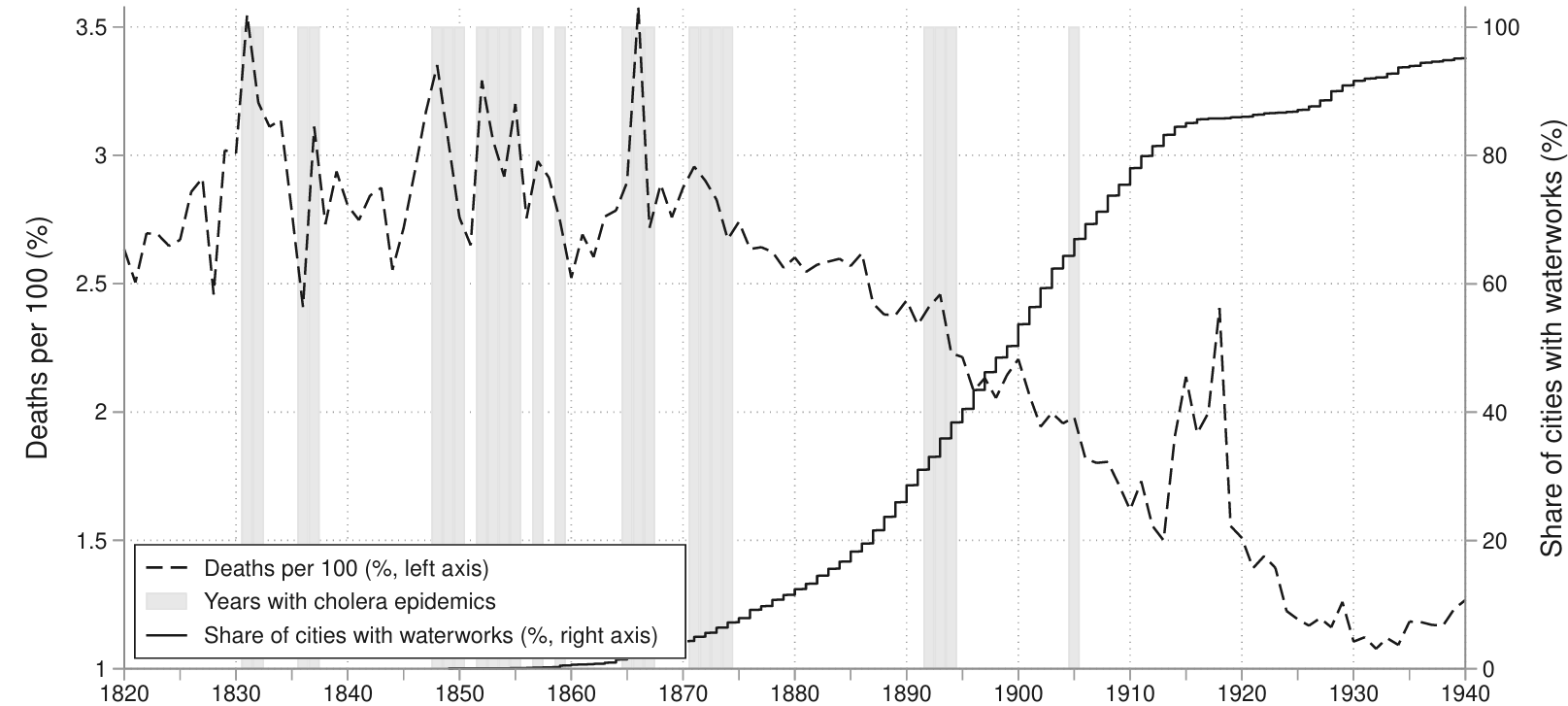
In the long run, these expensive investments clearly paid off. By 1911, cities exposed to the 1866 cholera shock were 11 percentage points more likely to operate waterworks than cities that had been spared. These earlier adopters not only experienced improvements in public hygiene and reductions in infant mortality; sanitary reforms were also associated with higher levels of human capital formation (higher-schools attendance), economic activity (stock-market listed firms), and innovation (patents filed). Ultimately, the findings suggest that the elites’ willingness to finance expensive public health infrastructure reflected a rational calculation of long-run economic returns. Waterworks played an indispensable role in the transformation of cities from high-mortality demographic sinks into places characterized by declining mortality and sustained human capital accumulation.
Link (pdf): Private Interest in the Public Good: Cholera and the Origins of Sanitary Reform